To Mr. Chief Justice, and may it please the Court:

I am writing on behalf of the more than 167.5 million women in the United States who now find themselves without access to basic healthcare as a result of the Supreme Court’s decision to overturn Roe v. Wade, 410 U.S. 113 (1973) and declare that access to an abortion is not a constitutionally protected right.

In issuing this Court’s majority opinion on Dobbs v. Jackson Women’s Health Organization, Justice Samuel Alito provides three reasons for this decision: the first being the word “abortion” does not appear in the Constitution; the second being a belief that the right to an abortion is fundamentally different from all other rights protected by the Fourteenth Amendment, and thus, is not protected by the amendment’s “due process” clause; and third being a belief that precedents are meant to be overturned rather than upheld in order to protect Americans from outdated laws and stereotypes.

I disagree with the first two points outright. And while I agree with the sentiment of the third point, I believe it has been egregiously misconstrued to support antiquated, harmful, inequitable, Christian anti-abortion theologies. In this letter, I will speak to each of the Court’s points and present a counter argument in support of the legalization of abortion.

I.)

The Court asserts that because the word “abortion” is not mentioned anywhere in the Constitution, it has the prerogative to determine if the right to an abortion is “deeply rooted in this Nation’s history and tradition” and “implicit in the concept of ordered liberty,” as it had done previously in ruling on Timbs v. Indiana, 586 U.S. ___ (2019) when Justice Ruth

Bader Ginsburg traced the illegality of excessive fines back to the Magna Carta, the English Bill of Rights signed in 1215.

The simple definition of “ordered liberty” is the regulation of freedoms for the purpose of maintaining order in society. According to this Court, the freedom to get a safe abortion does not constitute “ordered liberty” because “until the latter part of the twentieth century, such a right was entirely unknown in American law” (Dobbs v. Jackson 5).

I disagree. Where was the sense of “ordered liberty,” before Roe v. Wade, when women had to navigate the black market looking for abortive procedures and then protect themselves from possible sepsis contracted through nonsterile instruments inserted in the vagina and uterine cavity? Or when women who attempted “safer”, at-home abortion methods, including but not limited to exposure to extreme cold, still ended up dead from their procedure? And where is the “ordered liberty” today, after Dobbs v. Jackson, when women like Madison Underwood have to drive four hours across state lines to receive life-saving abortions? Or when a parentless, sixteen-year-old girl begs the Florida courts for an abortion because she self-identified as “not ready to have a baby,” but the Courts deemed she was too immature to make that decision?

There is no sense of “ordered liberty” in a country where the government prohibits access to life-saving medical procedures and instills a fear of death in half the population by taking away a crucial part of their healthcare. Therefore, I argue that recognizing abortion as a constitutionally protected right and legalizing the procedure would do far more to promote, ensure, and protect “ordered liberty” in the United States than declaring it illegal.

Continually, regarding the omission of the word “abortion” and the subsequent right to it from the Constitution, I ask the Court to consider the Ninth Amendment, which reads: “The enumeration in the Constitution, of certain rights, shall not be construed to deny or disparage others retained by the people.” Or in modern language: the rights expressly written down in the Constitution are not to be used to deny or infringe upon other rights NOT expressly written in the Constitution that the American people feel they possess.

The Ninth Amendment is the Constitution’s way of acknowledging that it is incomplete; the Founding Fathers knew they had not codified every possible right in the Constitution, either that existed in the 1780s, or that would exist in the future, such as the right to interracial marriage or to equal schooling for all children, regardless of race or gender. Alexander Hamilton admitted, in the Federalist Papers, that the Constitution “may not be perfect,” and thus, has procedures embedded in it by which it can change to better protect “the present views of the country” (Federalist No. 85), and most importantly to mitigate “the injury of private rights of particular classes of citizens, by unjust and partial laws” (Federalist No. 78). Pair this with the decision in Taylor v. Louisiana, 419 U.S. 522 (1975), which declares that the time in which women could be disqualified from jury service on the basis that they are inherently unfit “has long since passed…What is a fair cross section at one time or place is not necessarily a fair cross section at another time or a different place,” and the Court is obligated to enact laws that bolster our modern culture and beliefs, not uphold antiquated ideals.

The “present views” of the country are that abortion should be legal in some capacity, as evident in a study conducted by the Pew Research Center (Figure 1).
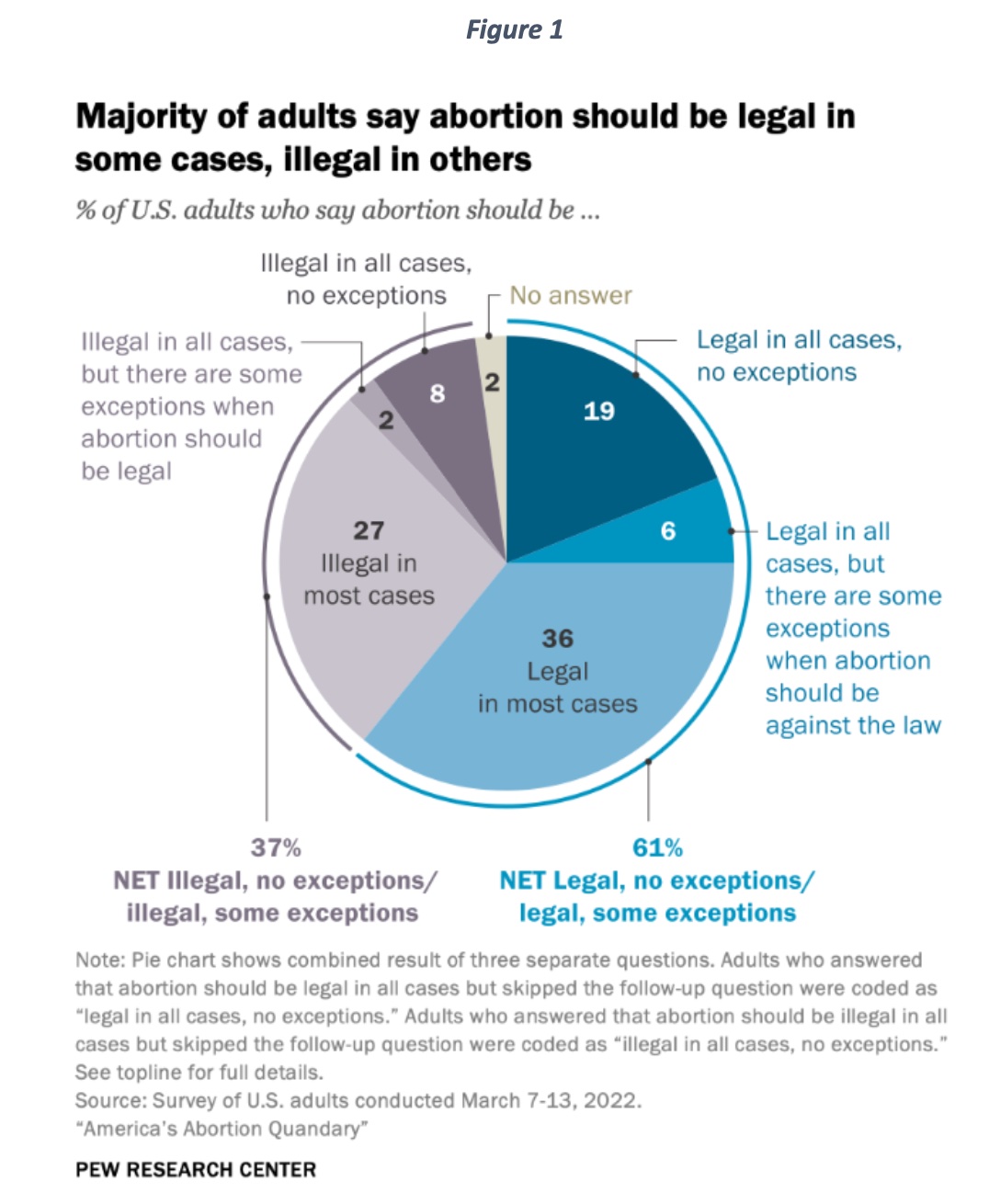
61% of Americans believe women should have access to legal abortions, and of the 37% of people who believe it should be illegal, 29% believe there are instances where abortion should be legal (for example: in cases of rape, incest, or risk of death to the mother). This totals to 90% of the population supporting abortion rights in some capacity.

Therefore, I argue that the legalization of abortion would better reflect the country’s “present views,” and be in best alignment with the Ninth Amendment, protecting “other rights retained by the people” outside the expressly written down Constitution. Basing modern jurisprudence on a literal interpretation of a document ratified in 1788 threatens to push the United States back to its antiquity.

II.)

The Court asserts that the right to an abortion is not protected by the Fourteenth Amendment and its declaration that no state shall “deprive any person of life, liberty, or property, without due process of law; nor deny to any person within its jurisdiction the equal protection of the laws.” As Justice Alito’s Court understands it, abortion is “critically different from any other right that [the Supreme Court] has held to fall within the Fourteenth Amendment’s protection of ‘liberty’,” such as rights involving intimate sexual relations, contraception, and marriage, because, unlike the aforementioned rights, abortion “destroys what [Casey and Roe] call “fetal life”,” and what Dobbs v. Jackson describes as an ”unborn human being” (Dobbs v. Jackson 13).

And this is where the greatest question in the abortion debate arises: is it more important to protect the life of the woman, or the life of the unborn child? Both lives are precious and unique, but as modern medicine makes it possible for babies to survive outside the womb earlier and earlier, and as abortion procedures get safer and more efficient, the two sides of the abortion debate find themselves colliding.

For the uninitiated feminist, “protecting the life of the woman” means more than just keeping her physically alive. It means more than providing her with basic medical care when her life is threatened during pregnancy or when her mental health deteriorates dangerously post-pregnancy. “Protecting the life of a woman” means protecting her quality of life as well. If having another child would force her and her family into poverty, she should not have to have the baby if she does not want to. If having a child means she would have to drop out of college when she desperately seeks a degree to further her future, she should not have to have the baby if she does not want to. And if having a child means holding on to a part of her rapist forever, she should not have to have the baby if she does not want to. If a woman is not ready to sacrifice her body and her way of life to a child, she should not be forced to have the child.

And conversely, for the uninitiated anti-abortionists, “protecting the life of the unborn child” means understanding the predominantly Christian theology that life begins at conception, and thus, abortion of a fetus is equivalent to murder of a human being. One of

the many biblical passages used to prohibit abortion and defend the sanctity of life is Psalm 139: 13-15, which says “For you [God] created my inmost being; you knit me together in my mother’s womb…My frame was not hidden from you when I was made in the secret place, when I was together in the depths of the earth” (NIV Bible). The speaker is acknowledging that her life began when she was conceived.

Another frequently used verse to support the belief that fetuses are fully-formed human beings is Exodus 21:22-25, which states, “If people are fighting and hit a pregnant woman and she gives birth prematurely…[and] there is serious injury, you are to take life for life, eye for eye, tooth for tooth, hand for hand, foot for foot” (NIV Bible). The ambiguity regarding who must experience the “serious injury” for the punishment to occur—the mother or the child—has led anti-abortionists to argue that the child must be “injured” for the punishment to occur, and therefore a fetus is equal to an adult human “eye for eye, tooth for tooth, hand for hand, [and] foot for foot.” I would make the counter argument that in this passage, the child only becomes equal to the adult human when it is born prematurely, when it exists outside the mother’s womb; this passage does not explicitly reference life in the womb, only life immediately following birth.

The U.S. Supreme Court began grappling with the issue of how to regulate and govern human reproduction in 1942, in the case Skinner v. State of Oklahoma, ex rel. Williamson, 316 U.S. 535. In this case, the Supreme Court ruled that forced sterilization of criminals was unconstitutional and that procreation is a fundamental right, making it one of the first cases to discuss reproductive rights in federal court.

Oklahoma’s Criminal Sterilization Act of 1935—which the Court made legal by declaring a similar Virginian law constitutional in 1927—permitted the sterilization of people convicted of three or more federal crimes; sterilization methods included a vasectomy for men and a salpingectomy (removal of the fallopian tubes) for women. Jack T. Skinner had been convicted of stealing chickens once and of robbery with a firearm twice, and a grand jury sentenced him to a vasectomy. Skinner appealed the verdict on the grounds that this punishment violated the Fourteenth Amendment.

The Court sided with Skinner and struct down the Oklahoma Criminal Sterilization Act on the grounds that 1) this was a cruel and unusual punishment for Skinner’s crimes, and 2) certain crimes had been excluded from the act’s list without explanation, and thus, the act did not treat every criminal equally.i However, and more importantly for our discussion about abortion, the decision briefly discusses what that Court deems a deprivation “of a basic liberty” and of “one of the basic civil rights of man”: the right to choose to have a child. According to Skinner v. Oklahoma, the government does not have the right to inhibit a man from having a child for any reason or by any method. Thus, I ask: if the government cannot take a way a person’s choice to procreate, why can it take away the reverse choice not to procreate (abort a fetus)?

And to those who might respond, “a woman made the choice to procreate when she had sex, and thus, she must live with the consequences,” I would argue: a man has a second choice after sex to leave the woman and child with limited to no legal consequences to himself. A woman should have the same second choice, post-sex with limited to no legal consequences to herself, which abortion allows, thanks to the advancements in modern medicine. If men have more choices and more opportunities post-procreation to live a life without the baby with few to no legal consequences, should they so choose, than women, then the law does not treat everyone equally and violates the Fourteenth Amendment’s “equal protection clause,” if nothing else.

III.)

Finally, Justice Alito’s Court believes precedents—more formally known as stare decisis, and more commonly understood as earlier legal decisions used as examples to guide in subsequent similar circumstances—are meant to be overturned when “egregiously wrong” (Dobbs v. Jackson 77). And while I do not disagree with this notion, I disagree with the application of this notion to abortion and the reversal of Roe v. Wade.

In this opinion, Justice Alito equates the Court’s decision with other landmark, precedent- reversing cases such as Brown v. Board of Education, 347 U.S. 483 (1954), ending “separate by equal” schooling; West Coast Hotel Co. v. Parrish, 300 U.S. 379 (1937), ending separate and unequal minimum wages for men and women; and West Virginia Board of Education v. Barnette, 319 U.S. 624 (1943), ending a compulsory flag-salute law in public schools.

In making these comparisons, Justice Alito betrays the fact that he does not understand why the Court chose to overturn those precedents. In each of those cases, the precedents they were based on—separate but equal education, different minimum wages for men and women, and compulsory flag salutes in public schools—restricted freedoms and promoted inequality in the United States. The subsequent watershed federal court cases deemed these restrictions and inequalities unconstitutional, and created a freer, more equal United States.ii

Dobbs v. Jackson takes away a woman’s right to decide if she would like to sacrifice her body to pregnancy, while every man in this country still has the right to decide if and when he would like to take a Viagra or get a vasectomy: men can safely and legally access modern medicinal technology to control the changes their reproductive systems force upon their bodies and women cannot. In taking away women’s freedoms, the Dobbs v. Jackson decision forces the United States backwards more than 50 years into a dangerous time when women were second-class citizens, relegated to childbearing and keeping house, rather than shepherding American culture and society forward. Thus, the Dobbs v. Jackson decision cannot and should not be considered anywhere near the same class of precedent- reversing decisions as Brown v. Board of Ed., West Coast Hotel Co. v. Parrish, and West Virginia Board of Ed. V. Barnette (and no sane constitutional or jurisprudence historian will ever equate it as such).

IV.)

Throughout Dobbs v. Jackson’s decision, Justice Alito makes sure to emphasize that in removing the federal legalization of abortion, the Court “returns the issue of abortion to

[the States and other Federal] legislative bodies, [which] allows women on both sides of the abortion issue to seek to affect the legislative process by influencing public opinion, lobbying legislators, voting, and running for office. Women are not without electoral or political power” (Dobbs v. Jackson 73). If the Court believes it can hide its “egregiously wrong” decision behind the exorbitant wealth and lobbying power of conservative and anti-abortion America, then to the Court I say: CHALLENGE ACCEPTED!

I will volunteer for any political campaign that seeks to elect a pro-choice candidate fighting to get my rights back.

And channeling my inner anti-abolitionist Sojourner Truth, who declared that “If the first woman God ever made was strong enough to turn the world upside down all alone, these women together ought to be able to turn it back, and get it right side up again! And now they is asking to do it. The men better let them,” to the Court I say: CHALLENGE ACCEPTED!

I will cast every vote I legally can to elect a pro-choice candidate fighting to get my rights back.

I am tired of asking “favors for my sex,” and for “my brethren to take their feet of our necks.”iii I implore and hope to empower all women to push the male foot off our own necks rather than wait any longer. To the Court we say: CHALLENGE ACCEPTED!

I yield my time to:
The women of Kansas, who successfully got out the vote to keep abortion rights in

the state constitution, against all odds (Kansas is the reddest state in the nation: Kansas voted for a Republican candidate in 33 of the 40 presidential elections in which it participated).

The members of Congregation L’Dor Va-Dor, a synagogue in Palm Beach County, Florida, challenging a new state legislation banning abortions after 15 weeks on the grounds that this law violates Jewish law, which is interpreted to say “abortion is required if necessary to protect the health, mental or physical

well-being of the woman.” While almost involved parties admit that this is a publicity stunt suit, it reminds everyone that Christianity and evangelical Christian ideologies pervasive throughout the nation do not and cannot, according to the First Amendment, have a monopoly on making laws regarding abortion and women’s reproductive rights,

Madison Underwood of Tennessee, for sharing her harrowing odyssey across four state lines to receive a life-saving abortion.

Jane Doe 22-B, the sixteen-year-old girl in Florida denied an abortion by the courts on the grounds that she was “not mature enough.” (If she is not mature enough for an abortion, what makes anyone think she is mature enough to carry a child to term and give birth?)

All women seeking an abortion in states keeping that right from you.
All legislators of all genders and ideologies fighting for reproductive rights at all

levels of government.
And all activists of all genders and ideologies who continue fighting for reproductive

rights in any way they know how.

Thank you.

——————–

i This case was decided soon after World War II, and the Court recognized that sterilization laws could lead to masked eugenics (as had occurred in Nazi Germany), and required strict scrutiny “in a sterilization law is essential, lest unwittingly, or otherwise, invidious discriminations are made against groups or types of individuals…[which] can cause races or types which are inimical to the dominant group to wither and disappear.” This provided another reason, outside of the facts of Skinner’s particular case, to strike down the Oklahoma Sterilization Act.

ii While we still have very far to go in seeing a truly free and equal society for all U.S. citizens regardless of race, gender, or religion, without these cases, the country would still be centuries behind.
iii The original quotation is attributed to Sarah Grimké who said she would “ask no favor for my sex. All I ask of our brethren is that they take their feet off our necks.” It was a favorite quotation of Justice Ruth Bader Ginsburg when she was defending women’s rights and building the foundation of gender equality law before the Supreme Court.

Leave a Reply